Convergences & Pillows of Air
CONVERGENCES
Following the publication of Everything that Rises in 2007, the McSweeney’s.net website hosted a contest in which readers could submit their own instances of such convergence phenomena and I got to choose my favorites and then respond (sometimes, for that matter, I posted my own). The full run of that eventually four-year run can be accessed here (opens in new tab). Below are a few of the later entries from the original contest to get you in the mood.
Apoptosis: A Boom/Cancer Convergence
So, I happened to be in Posman’s, the independent bookstore at Grand Central, the other day, and noticed these two books stacked one beside the next.
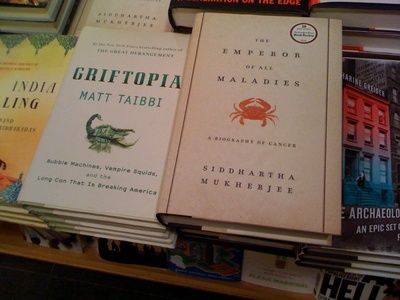
Which is to say, Rolling Stone ace reporter’s Matt Taibbi’s Griftopia: Bubble Machines, Vampire Squids, and the Long Con that is Breaking America, and Siddhartha Mukherjee’s National Book Award-winning The Emperor of all Maladies: A Biography of Cancer. And I suspect that, like you, I couldn’t help but be struck by the similarity in the cover images. Which in turn got me to thinking about an op-ed piece Walter Murch and I contributed to the Los Angeles Times about a year ago (May 23, 2010), which I herein offer as a gloss on this particular not-so-innocent coincidence.
- - -
Economy: The Trouble With Bubbles.#
“I can calculate the movements of the stars, but not the madness of men.”
— Isaac Newton, after losing the equivalent of $3 million in the financial catastrophe of the South Sea Bubble in 1720.
The word “bubble” just has an inescapably happy feel to it, conjuring up kids and parties and sudden iridescent poppings, screams of laughter, the giddy clapping of happy hands and an overall lack of consequence. That was fun; now where’s the cake?
Even more so when the word gets paired with “tulip” or “South Sea.” Where could the harm possibly be in such blithe and fragrant things? Certainly not in the words themselves: exotic petals, swaying grass-skirted maidens, spheres of trembling insubstantiality.
Things get a bit more pedestrian with the more recent dot-com and housing bubbles. But still, seriously, where’s the harm?
Well, to paraphrase Christopher Wren’s epitaph: If you seek its monument, look around you. The financial wreckage from this last housing bubble (that outbreak of “irrational exuberance”) is still being inventoried, and its consequences are considerably more serious than the wet smacking pop associated with the word itself. Nor was there any cake (unless it came in the form of those sweet bonuses handed out as party favors to the executive celebrants up and down Wall Street).
And yet, despite the economic damage of the last few years, we are repeatedly soothed by the innocence of the word “bubble” itself. Lulled by language, we’re invited to contemplate, with relative equanimity, simply getting to hear that fateful “pop” every so often, as the inevitable price to be paid for the market freedoms of the unregulated capitalistic system. Ah well: Kids will be kids.
But what if we were to conjure another metaphor? Perhaps a more apt analogy. Might it help rouse a more pertinent response?
Take, for example, the constantly surging froth of pre-cancerous cells in each of us. At any given moment, a rogue cell might somehow lose a sense of its place in the organism — that it is a liver cell, say — and instead believe itself to be alone in a hostile, plunderable environment. This is not surprising when you consider that there are 50 times more cells in a human body than there are stars in the Milky Way: 10 trillion versus 200 billion. Something’s bound to go wrong somewhere. Under such circumstances, the rogue cell’s raison d’etre becomes: “Defend. Survive. Dominate: Be fruitful and multiply.” And so it does, using the local environment — of the liver in this case — as a food resource to be exploited by whatever means necessary
For most of us, most of the time, this pre-cancerous froth never proves a problem because there is a regulatory agency — the immune system — that quickly identifies those rogue cells, reminds them who they really are and encourages them, as it were, to commit suicide, a process known as apoptosis. This fatal encouragement can come spontaneously from within the cell itself (suddenly recognizing its own roguishness) or from the surrounding healthy cells (a neighborhood group enforcing community standards) or from immune-system “police” cells patrolling the body as a whole. This process is happening constantly, is part of the normal functioning of the healthy organism and gets accomplished without any awareness on our part.
Trouble occurs when, for some reason, the normal functioning of apoptosis breaks down — the cell’s own compunction fails to kick in, the surrounding cells prove too weak or are otherwise distracted, the local regulatory agency is asleep at the switch — and the cell in question cannot be persuaded to end its life. Instead, it multiplies exponentially, becoming the seed of a cancerous tumor. Only now, at a certain threshold, does the greater organism become aware of it, and an existential conflict ensues.
The tumor is now set against the interests of the greater organism of which it was once a part. Its brief is to flourish at all costs, to thrive at the expense of the surrounding healthy tissue. Followed to its inevitable conclusion, this means doom for both the host and the tumor. Though, of course, until that dreadful “pop,” the tumor doesn’t see it this way.
What would it be like to think of the travails of the wider economy, the coursing flow of capital through the body politic, in those terms? (It’s worth remembering that when the sainted Adam Smith first began to ponder the circulation of capital in the seminal explorations that would lead to his monumental “Wealth of Nations,” he was quite consciously modeling his inquiry on William Harvey’s investigations into the circulation of blood a few generations earlier.)
What if, instead of that playful word bubble, we tried something a bit more accurately descriptive when growth at any cost became the goal. Say, “tumor”: “the dot-com tumor,” “the subprime tumor,” “the derivatives tumor.”
Would anyone seriously gainsay the highest possible vigilance over the proper functioning of their own body or doubt the need for strong regulation? Who, facing the prospect of a tumorous outbreak or living with a body demonstrably prone to such outbreaks, would entrust that body to a band of physicians blithely committed to laissez faire regarding these fatal bubbles of flesh?
Words matter. Metaphors frame thought. Pay them heed and tend them well.
Bearded Ladies Breastfeeding
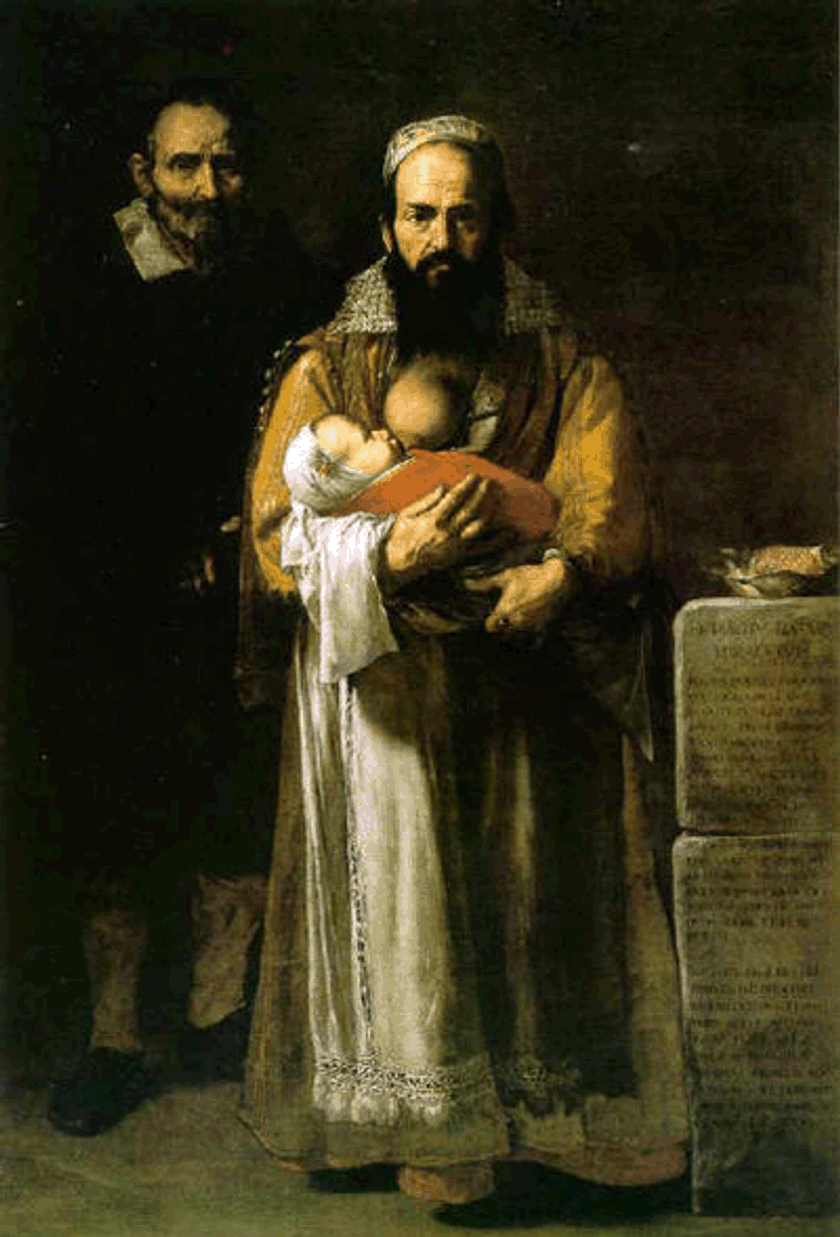
So I recently happened to be in Madrid for a few days and took advantage of that fact to stroll once again through what is arguably the world’s greatest collection of old masters paintings, that of the Prado, which is where I came upon the astonishing triple-portrait above, dated 1631, by the then-Naples-based Spanish tenebrist master Jusepe de Ribera (apparently on loan from a museum in nearby Toledo).
As you’ll doubtless agree, it’s a hard image to shake, and back at the hotel I took to trawling the internet for background information, which is how I came upon the following entry from University of Maryland professor Jeff Matthews on his “Around Naples Encyclopedia” blog:
The title of this painting is simply Bearded Woman and it is from the year 1631. The painting is now in the permanent collection of the Museo de Tavera in Toledo. The subjects were husband and wife, Felix and Magdalena Ventura. Even before the painting, Magdalena Ventura was famous. She was not really from Naples, but rather from somewhere in the nearby Abruzzi. She was already a grown woman with several children before her beard started to grow in thick and full like a man’s beard. When the Duke of Alcala, the Spanish viceroy of Naples at the time, heard about her, he invited her to come into the big city and sit for a painting by de Ribera, the Duke’s own court artist and one of the leading painters of the time. Magdalena’s fame spread such that she was mentioned in court correspondence throughout Italy, reflecting perhaps all of our lasting fascination with weirdness. The Duke and his quack medicos certainly weren’t up on such things as androgen excess or perhaps the rare genetic disorder known as hypertrichosis; they just thought, Holy Cow, a bearded lady. (I think the expression “Holy Cow” comes into English from India; it doesn’t exist in Italian or Spanish, so the Duke probably said something else.) But enlightened minds such as yours and mine are, indeed, up on such things as androgen excess and hypertrichosis, and we still think, Holy Cow, a bearded lady.
Holy Cow, indeed. And yet it seemed to me somehow that there was more to the uncanny power of this image than merely bovine hirsute mama associations.
And then I recalled a parallel set of unsettling visual provocations from back in my own days reporting Poland’s transition from out of Communism for the New Yorker, in this instance from the magazine’s issue of December 11, 1995, where I profiled Jerzy Urban, the roundly despised and just as roundly despising Jewish government press spokesman of Warsaw’s prior martial law regime. Mr. Urban had gone on to become one of the country’s richest men, following the transition, by founding the deliriously scandalous gutter rag, Nie (which is to say, “No!”), part Screw magazine and part Canard Enchaine, the venue for a whole slew of outrageous stunts. As I reported at the time (the piece is also included in my collection, Vermeer in Bosnia, though unlike there, in what follows I intersperse the relevant imagery):
Perhaps Urban’s favorite “happening,” though, was the time he conned the newly reopened Warsaw luxury Hotel Bristol into getting itself certified kosher [the better to cater to the exponentially expanding holocaust tourism trade]. He pulled out an issue of Nie and, turning to a photo spread, showed me how an actor—or, rather, a young actress—had been disguised as a hunched, bearded, and bedraggled old rabbi and had been driven to the hotel in Urban’s Jaguar; and how the “rabbi” had thereupon dragged the hotels’ prim-and-proper female business manager all around the establishment, peppering her with arch questions.
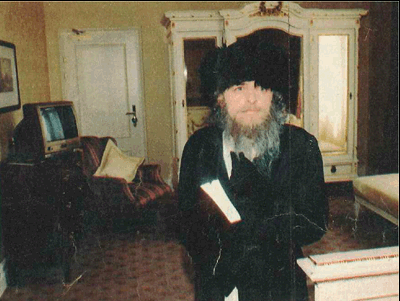
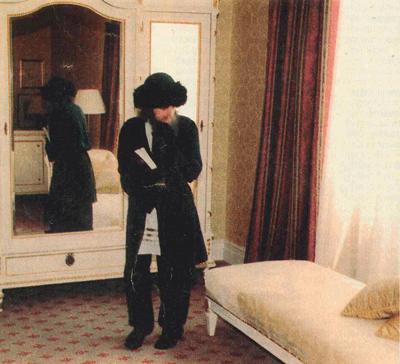
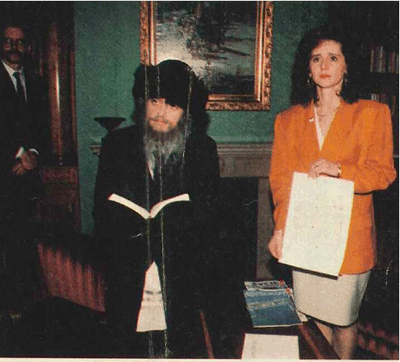
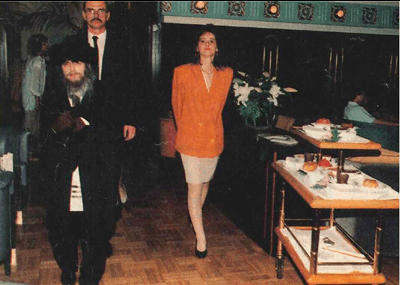
“It was great,” Urban declared. “We made a complete fool of this business-manager lady.” (“Yeah, she’s probably committed suicide by now,” one of my friends subsequently commented. I asked what she had done to deserve such treatment. “Oh, her just being a woman is generally provocation enough for Urban,” my friend replied.) Urban continued, "And here the rabbi is signing the certificate—look at the manager, look at how tense she is.
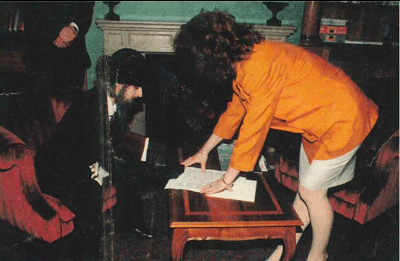
It’s hilarious. And then here we have the rabbi being escorted back to my Jaguar, and then here…" Urban was speechless with satisfaction: the last picture showed the “rabbi” back in the Jaguar, a few blocks away, her black coat removed, her white shirt opened, her beard gingerly pulled aside as she breast-feeds her child. The photograph was captioned “Rabin z dzieciatkiem,” the latter being a word for child used almost exclusively in the expression “Madonna and Child.” It was a combination of image and caption almost precision engineered to fry every nationalist circuit in the Polish imagination. Urban smiled broadly and declared his labors good.

Which in turn has gotten me to thinking about that Ribera image again.
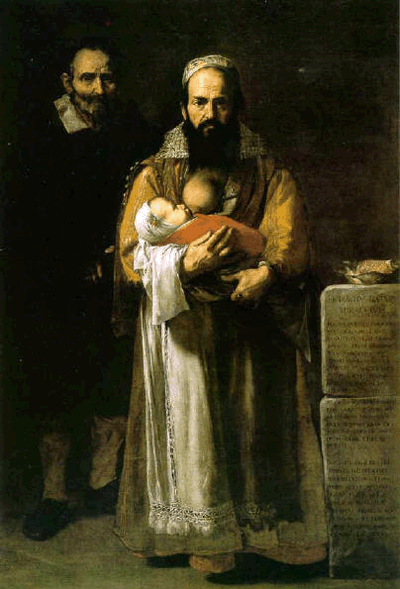
Because that isn’t just some bearded lady breastfeeding her baby. That’s a bearded lady who looks very much like a rabbi—of the sort Rembrandt was painting during the same period, as in this instance, now at the Hermitage in St Petersburg, from a few decades later (1654, note the cap):
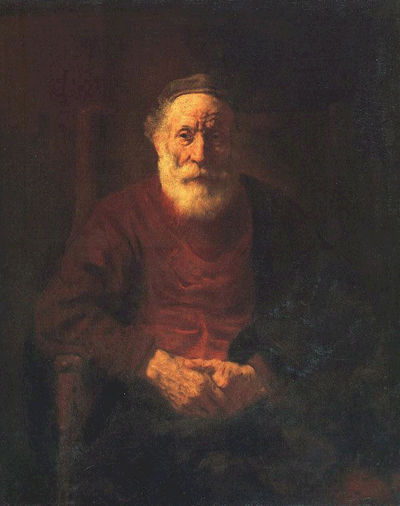
My good friend, the poet Stanley Moss, himself a longtime distinguished dealer in Old Master paintings, tells me I’m crazy to be advancing this hypothesis—that is, that there is something oddly Jewish about the way de Ribera has chosen to portray his breastfeeding bearded lady. But I don’t know. And it’s not as if it wouldn’t have been as loaded a depiction in its time (1631) as Urban’s was in his place: a Spanish painter, after all, in the wake of the expulsion of the Jews from Spain in 1492, and the centuries thereafter of Inquisitional anxiety about the persistence of secret conversos in the country’s midst (with all of Europe, for that matter, still wrestling with its Jewish problem: The Merchant of Venice, 1598; Don Quixote, 1605 and 1615; Spinoza born the very next year, 1632)—portraying a bearded rabbina, that is, Madonna-like, breastfeeding her infant, with her haggard husband gazing on, Joseph-like, from the shadows.
It’s just a really odd painting, is all I’m saying.
Carnival of Convergences No. 8
By Carol Rosofsky, Eric Lidil, Lawrence Weschler and Matt Haber
- - - -
Bangkok and the Noonday Sun
Submitted by Matt Haber
- - -

Protesters in Bangkok, 2010.
Photo: Adrees Latif/Reuters.
- - -
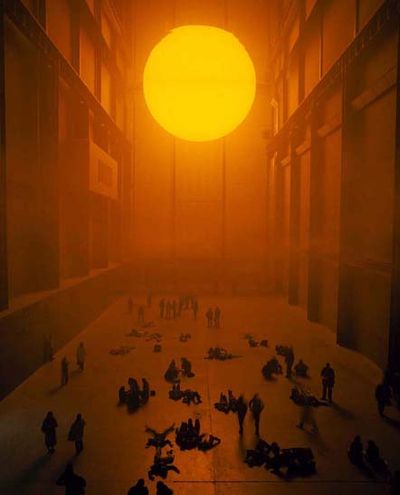
Olafur Eliasson’s 2003 installation “The Weather Project.”
In Turbine Hall of London’s Tate Modern.
- - -
Tubaned Epiphanies
Submitted by Carol Rosofsky
- - -

Hajji Abdul Zahir, far left, the district governor of Marja, oversees payments by the Marines to Afghans in the region. Photo by Moises Saman for the New York Times.
- - -
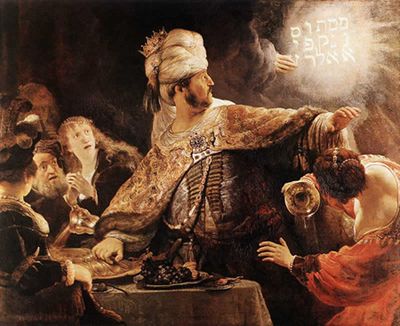
Rembrandt’s Feast of Belshazzar (c. 1635).
- - -
The Bagmaker
Submitted by Eric Lidil
- - -
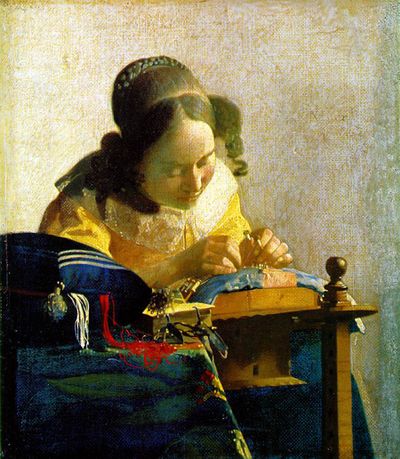
Vermeer’s The Lacemaker (1669).
- - -
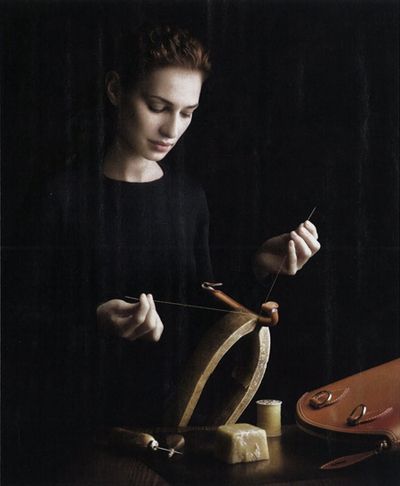
Louis Vuitton ad in the November 30, 2009 issue of the New Yorker.
Mr. Lidjl notes that, just as in Vermeer painting where (as Weschler pointed out in Everything That Rises), the lacemaker is gazing down on the tight crisp V of thread couched in her M-like hands, hence spelling out the author of her own existence, VM—so in this ad, the bagmaker is gazing down on an L of thread spread atop that inverted V-clamp, hence LV, the very sponsor of the ad in question.
- - -
Bricks
Submitted by Matt Haber
- - -
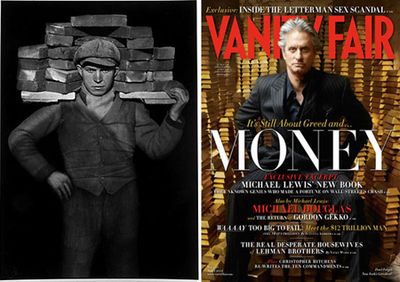
Left: August Sanders’ Bricklayer (1928).
Right: April 2010 Vanity Fair cover, photographed by Annie Leibowitz.
Mr Haber’s second winning entry in the current carnival.
Mr Haber notes: “The cover of the April 2010 issue of Vanity Fair (shot by Annie Leibovitz) strikes me as an homage to August Sanders’ Bricklayer (1928). Leibovitz has appropriated thousands of fine art images over the years, so I have to assume it’s intentional, but recasting an image of a proud working stiff from Weimar, Germany as Michael Douglas playing Gordon Gekko, the pampered Wall Street crook is a bit, um, well, rich.”
- - -
Demi on the Clamshell
Submitted by Lawrence Weschler
- - -

Demi Moore on the cover of the March 2007 issue of Architectural Digest.
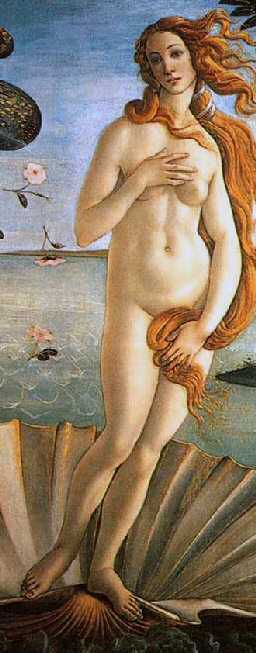
Botticelli’s Birth of Venus (1486).
- - -
Eerie Premonition
Submitted by Matt Haber
- - -
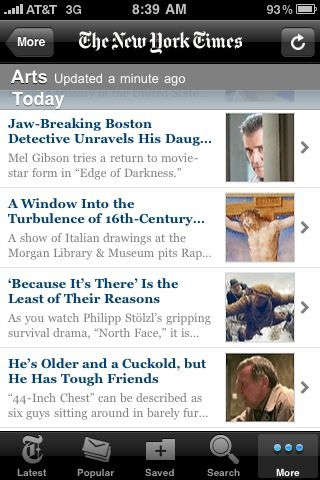
When Mr Haber submitted this catch off the January 29, 2010 New York Times website, his third winning entry in the current carnival(!), he was presumably calling attention to the droll way Passion of the Christ’s Mel Gibson peers from behind the cross-like doorframe as played off the image below that, and how that image in turn played off the crucified-like stance of the guy in the one below that. But today the fourth image in the series, or rather the title of the review it illustrates, plays all the more uncannily off Mr. Gibson’s recent travails—or should we say, Passion?
“We are the Son” by Danny Erker
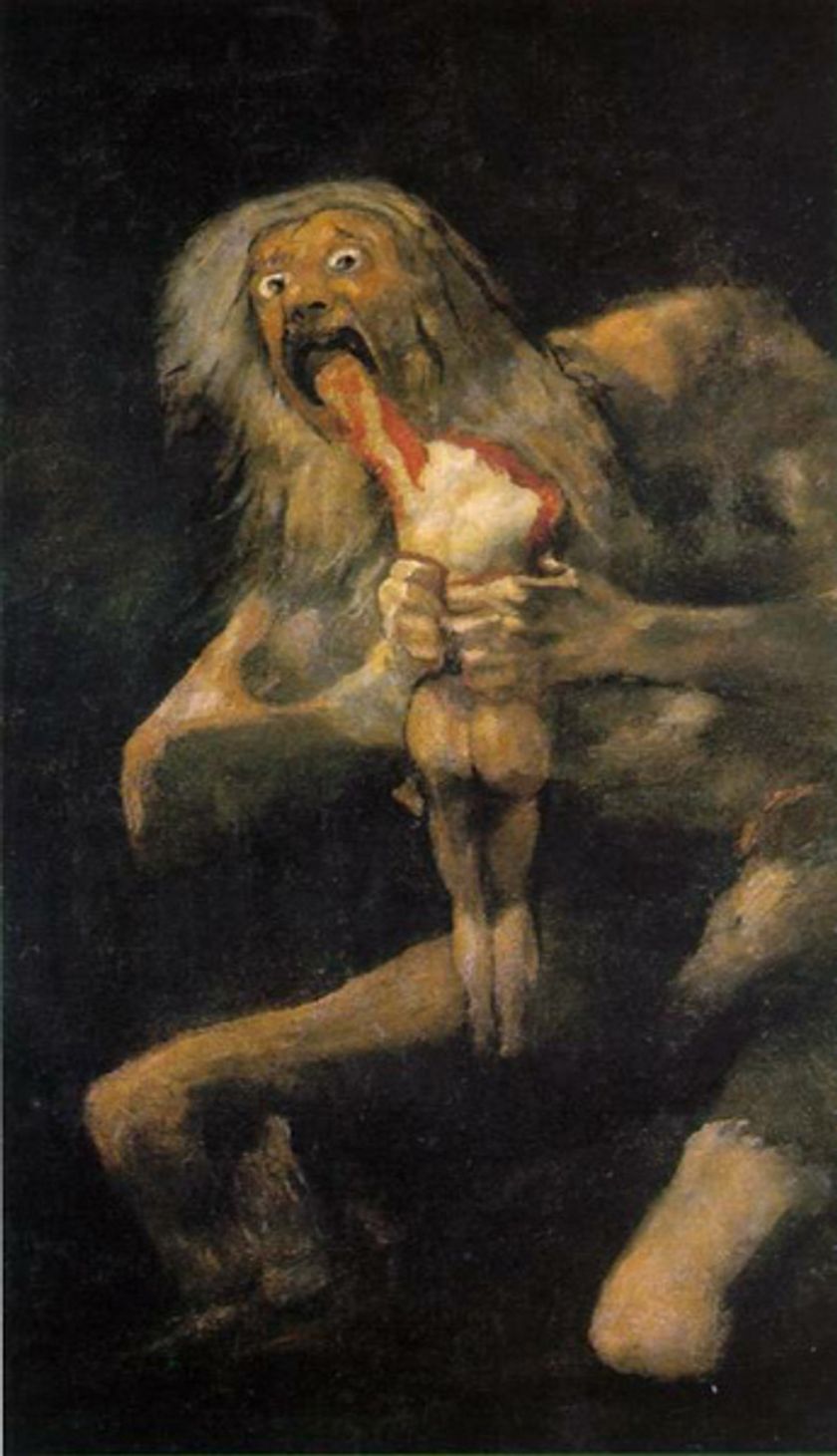
Ever since I stood face to face with them in Madrid’s Prado Museum, I’ve been completely creeped out by Goya’s Pinturas Negras. Easily the grossest in that series is Saturn Devouring One of His Sons. In it, the Spanish master depicts the terrifying image of a deity so drunk on power and mad with fear that he eats his own. Cloaked in black, his white knuckles emerging in a tenebristic fit of cannibalism, Saturn himself is only slightly less revolting than the notions he conjures up: the mythic father, epitomic manifestation of patriarchal protection, so enslaved by his will to dominate that he’s willing to squander the fragile potential of youth in a gluttonous fit to satisfy himself.
Thank God it’s just a painting.
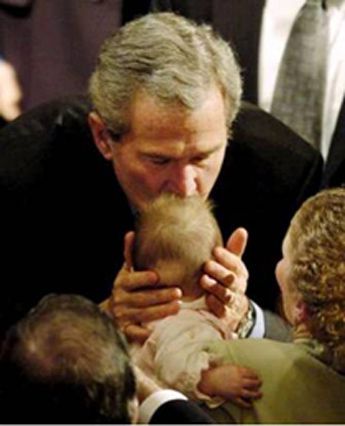
Weschler responds#
Amen to that, Daniel. Amen to that.
Pillows of Air
Beginning in the November 2013 issue of The Believer, Weschler launched a new series, "Pillows of Air," which we will be posting here after each issue leaves the newsstand.
The Omnivorous Eye
From The Believer, November/December 2013
“The Omnivorous Eye.” That being the name we’d been thinking of using until only just recently for the monthly column we’re launching with this issue. Had we done so, it would have been in knowing commemoration of a stillborn project of my own from over a decade ago, a utopian semiannual publication I’d taken to calling Omnivore (I even went to the trouble of trademarking the name), which in the event saw only a single prototype issue (with a photo of a bird in the hand on its cover), the few remaining copies of which can be procured from one sole place nowadays (the bookstore of the Museum of Jurassic Technology, naturally, or its website).
So, anyway, Omnivore, in token of the sheer range and breadth of appetite one hopes to be indulging. And “The Omnivorous Eye” as a sort of doff to the great, mad curator Walter Hopps, who, in March 1957, launched what would become the legendary Ferus Gallery in Los Angeles with a group show called Objects on the New Landscape Demanding of the Eye, which, come to think of it, might also have been a good name for this column. Hopps went on to helm the Pasadena Museum of California Art (where he curated the first Marcel Duchamp retrospective anywhere in the world, in 1963), and then the Menil Collection in Houston. (He died in 2005.) Walter liked to say that his was an age-old vocation: he was the one who found the cave and held the torch.
So, right: “The Omnivorous Eye.” Except that then I got Cold Feet. Suddenly over the last several days, I have found myself unable to shake the name’s associations with that other splendid exhalation of late ’50s culture—which, come to think of it, must have been being filmed during the very same months that Ferus was coming into being—that incandescently cheesey (albeit sublimely weird) black-and-white special-effects horror thriller The Crawling Eye.
The film must have screened five hundred times over the local TV station’s 4 p.m. matinees of my preadolescence, endlessly unfurling its tale of a giant, tentacled, free-floating eyeball, swathed in its own (radioactive!) cloud, nested snug in its high alpine redoubt, except on those occasions when it chose to come oozing down the mountainside for a gruesome human repast. Surely I could not have been immune to the eye’s “cold hypnotic stare,” as the film’s trailer has it, “striking fear into the hearts of all, creating a frenzied nightmare for all who beheld it.” Starring Forrest Tucker and Janet Munro.
OK, so maybe not “The Omnivorous Eye” after all. But if not that, what? It occurred to me that back at the time of the launch of my ill-fated journal, another name we’d been thinking of giving it was “Pillow of Air,” which had perfectly described the reigning aesthetic of the enterprise, in that it invoked those moments of hushed astonishment or absorption when a pillow of air seems to lodge itself in your mouth and you suddenly notice that you haven’t taken a breath in a good ten seconds.
The sort of experience where you get lost to yourself and given over to the marvel of all creation (indeed, to everything but yourself). The sort of experience that I propose to try and evoke in the columns that follow: strange, unexpected convergences, stand-alone astonishments, objects on the new landscape demanding of the eye. It’s interesting in this context to note an observation from the seminal old University of London philologist Richard Broxton Onians, in his incomparably bounteous and peerlessly titled The Origins of European Thought about the Body, the Mind, the Soul, the World, Time, and Fate—and, trust me, it is all that and more, and, come to think of it, it was published in 1951, just a few years before Ferus and The Crawling Eye. Through scrupulous attention to the histories of several key words in ancient Attic Greek, Onians is able to show that the Ancient Greeks conceived of the workings of the eyes and the lungs as very similar, that in effect the eyes not only breathed in (i.e., took into themselves the full expanse of the visual world) but also breathed out (i.e., sent their gaze out into that world in quest of particular details). In other words, seeing was breathing, the mind flowing into and out of the world through the pupils of the eye. Pillow of air, indeed.
And so, without further ado—breathe in, breathe out—my first column in this new series:
From Mecca to Ground Zero and Back
From The Believer, November/December 2013
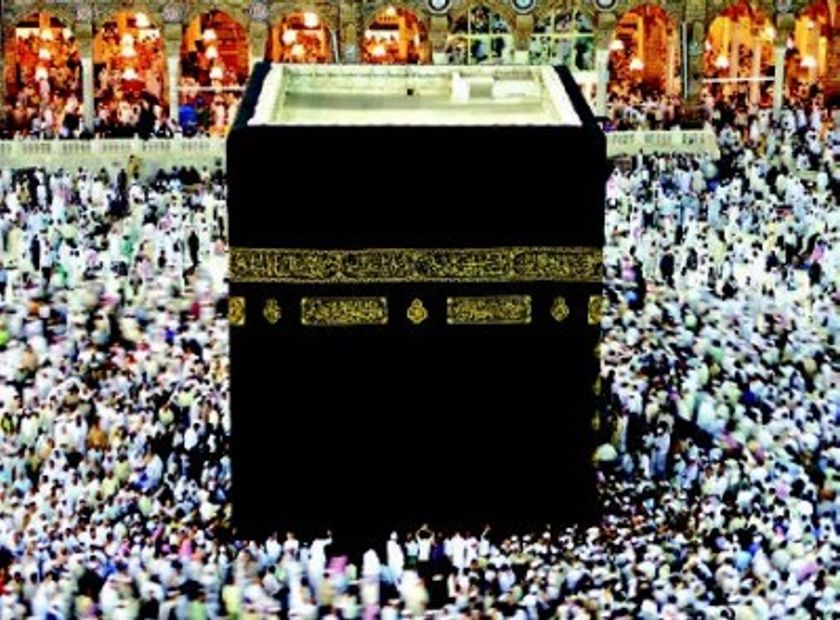
As I was reminded this past October, the hajj, the annual Islamic pilgrimage to Mecca, which every devout Muslim is required to undertake at least once in their lives, begins with the Tawaf, the first of seven ritual actions taken during that week, consisting of a counterclockwise circumambulation around the Kaaba, the holy of holies, a massive black cube building slotted in the middle of the vast interior plaza of the Al Masjid al Haram mosque (said to be the first house built for humanity to worship Allah, indeed long before the days of Muhammed, all the way back to the time of Abraham, who was said to have worshiped there).
Irwin/Longo/ Morandi/Piero/ Snyder
From The Believer, January 2014
A few months ago, early one midsummer evening, I happened to be up on the fourth floor of the Whitney Museum in New York, experiencing—or perhaps I should say reexperiencing—its restaging of Robert Irwin’s legendary 1977 Scrim veil—Black rectangle— Natural light installation, the piece in which the California artist had emptied out virtually the entire floor, stripping it down to its barest essentials (the dark slate flooring, the gray hive ceiling, that stark trapezoidal window off to the side) and then bisected the resultant vast empty space with a shimmering, pearlescent expanse of white scrim, held taut from ceiling down to eye level by a black metal bar, which in turn echoed the black painted stripe he’d applied to the perimeter of the rest of the room: that and nothing more. A piece, in short, that forced one to find one’s bearings in the midst of a free fall in one’s initial expectations (and to savor the marvel of how one is always having to adjust one’s bearings like that: falling, gauging, steadying)—and then, beyond that, that allowed one to experience the sheer hushed marvel of natural light itself, spreading (as if in a Vermeer) like a tide across the scrim-cut room.
Falling Forward: Irwin, Turrell, the Newsroom twins, Costa Concordia, Cartier-Bresson
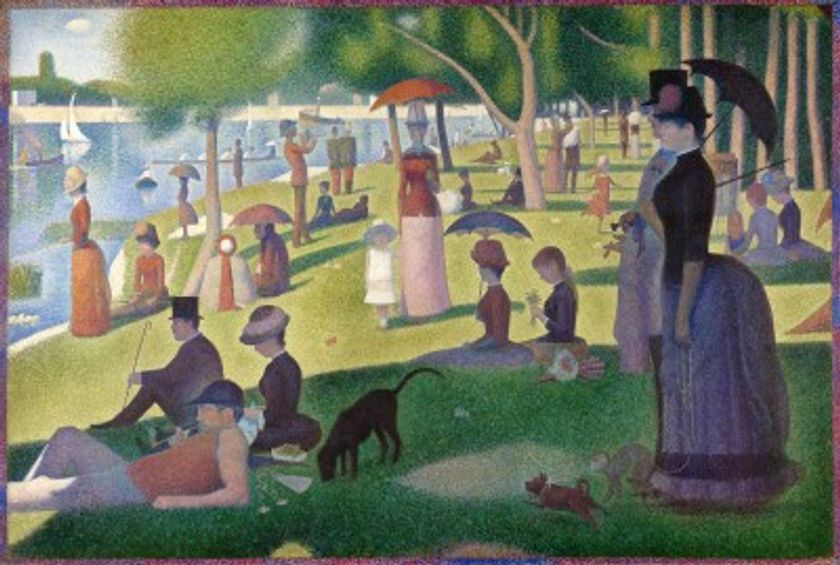
From The Believer, February 2014
Remember how last time we were talking about Robert Irwin and his brilliantly confounding installation at the Whitney—the restaging, this past summer, of that 1977 piece of his in which museum visitors were delivered from out of the elevator onto an amorphous fourth floor entirely pithed of its usual internal walls and struts and light fixtures and transfigured into a seemingly empty footballfield- sized space (all ceiling hive and slate-grid floor), though one bisected by a vast, translucent swath of taut scrim, stretching all the way across the length of the vastness from the far left to the far right, from ceiling down to eye level, whose fabric seemed to catch and hold the natural light of day as it poured forth, tide-like, from that strange, trapezoidal window way over to the left: a space, in short, initially almost impossible to put together in one’s mind, the occasion for a sort of perceptual free fall in which one actually got to experience, momentarily, as if in drop-jawed slow motion, all the sorts of things one is constantly doing to get one’s perceptual bearings in the world? Getting to “perceive oneself perceiving,” as Irwin likes to frame things, being for him the ultimate function of art.
Tim’s Vermeer - Vermeer’s Music Lesson - Marker’s La Jetée
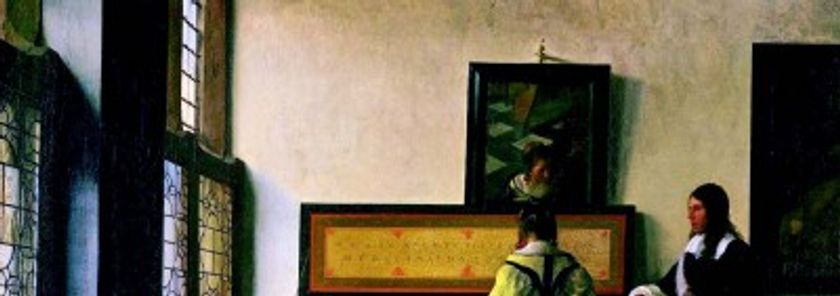
From The Believer, March/April 2014
This being the film issue and all, I thought I’d try my hand at a piece about arguably the greatest filmmaker of all time—great-grandfather, at any rate, to all the rest of them—that being, of course, Johannes Vermeer of Delft.
The animating occasion for this meditation: the recent release of Tim’s Vermeer, the magician-skeptics Penn and Teller’s documentary film about their Texas-based inventor friend Tim Jenison and his remarkable experimental investigations into precisely how the seventeenth-century Dutch master might have been able to render all those astonishing paintings. And I should say at the outset that Jenison, for his part, comes off as a wonderfully ingenious and thoroughly congenial fellow. And who knows? He may even be right.
Atomic Cuneiform
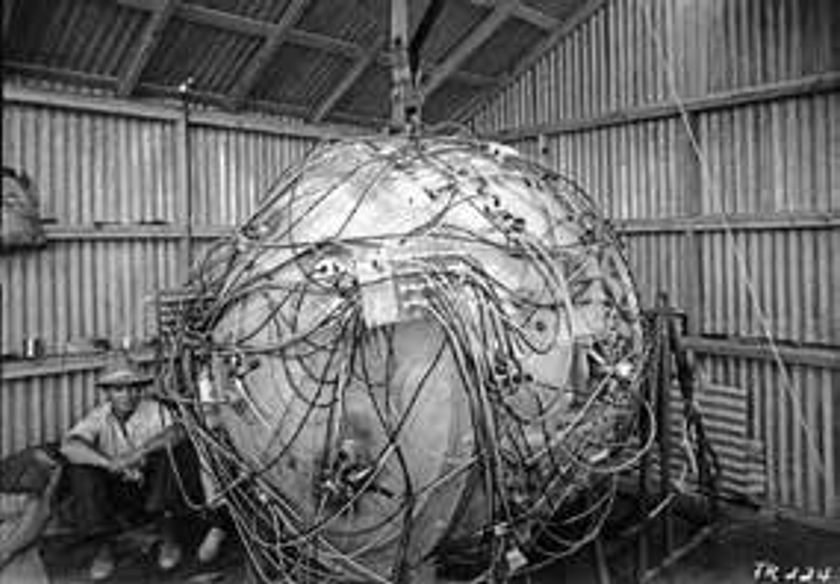
From The Believer, June 2014
One morning a few years back, I happened to be walking along South Ellis Avenue on the University of Chicago campus when I noticed a plaque marking the site where Enrico Fermi and Leó Szilárd and their colleagues achieved the world’s first nuclear chain reaction, on December 2, 1942, right there inside what were then the squash courts, tucked under the bleachers of the university’s Stagg Field. Drifting into a nearby building, I came upon a little commemorative display, including a drawing of the atomic pile itself, a remarkably makeshift-looking assemblage of graphite blocks housing uranium pellets which bore an uncanny resemblance to some sort of Babylonian temple from the times of Nebuchadrezzar (or, anyway, Indiana Jones’s approximation of same), and then, as well, a photograph of the Trinity device, direct descendant of that Chicago pile whose detonation in the New Mexico desert a mere two and a half years later, just as the sun was rising on the morning of July 16, 1945, signaled the astonishing triumph of the Manhattan Project and of course plunged mankind into a portentously new era all its own. (“Now I am become death, destroyer of worlds,” the project’s leader, J. Robert Oppenheimer, subsequently recalled thinking as he watched the mushroom cloud rising high into the blackened sky, famously invoking that harrowing line from the Hindu Bhagavad Gita.)
Las Meninas/Dutch Still Life

From The Believer, July 2014
Take a look at this entirely captivating department store ad, ubiquitous a few seasons back on the streets of Madrid, a sly pastiche riff on one of the city’s other premier attractions, arguably the greatest masterpiece in Madrid’s greatest museum, the Prado—Velázquez’s career-defining masterpiece of 1656, Las Meninas. It’s an interesting thing about pastiches, because, as often happens with the genre, the copy helps reveal some of the deeper splendors couched in the original. Note how, in the ad, a photographer- dandy stands in at the same spot occupied by the painter in the painting, gazing intently, along with the rest of his crew of costumed models, into his own reflection in a wide facing mirror, it would seem, camera at his waist, getting set to snap the very image we now see before us—maybe even doing so at this very instant, with the image in the ad being the result.
Destroy This Mad Brute: The African Roots of World War I
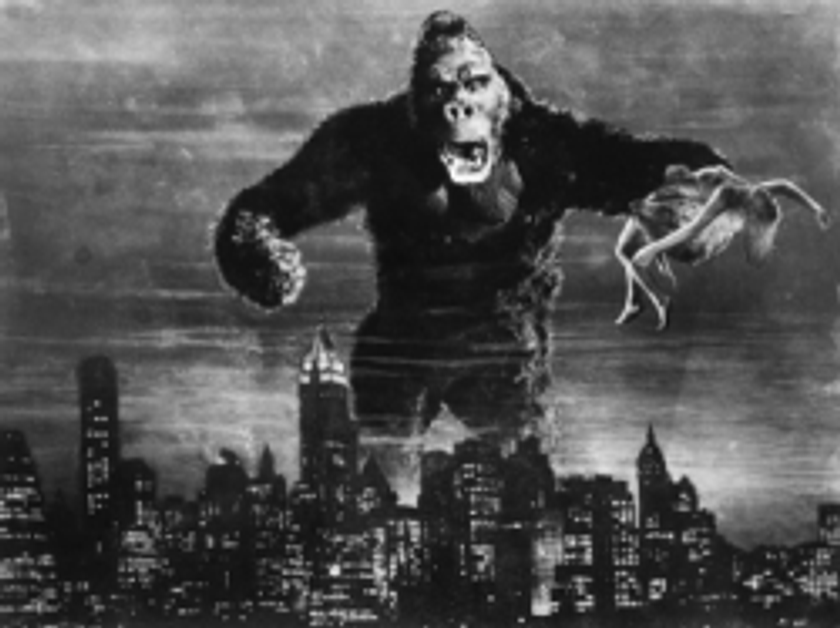
From The Believer, September 2014
The coming 100th anniversary of the start of the First World War has been pouring forth a whole variety of stark and sobering images, but the one that really startled me the other day was a US Army enlistment poster, from 1917, fashioned by the noted stage designer H.R. Hopps and in turn based, we are told, on a whole slew of British propaganda images from earlier on in the war: a huge, hulking, drooling man-ape, capped by a pointed Kaiser-helmet (labeled “militarism”), wielding with one arm a mammoth wooden club (labeled “Kultur”), gripping a half naked fainting maiden in the other, coming lumbering out of the sea onto dry land (labeled “America”), the abject ruins of his European depredations smoldering in the far distance behind him: “DESTROY THIS MAD BRUTE” implores the none-too-subtle poster’s none-too-subtle headline. And we are off: welcome to the rest of the century.
Poolside with David Hockney, Richard Feynman, a pair of Twins and some Bugs
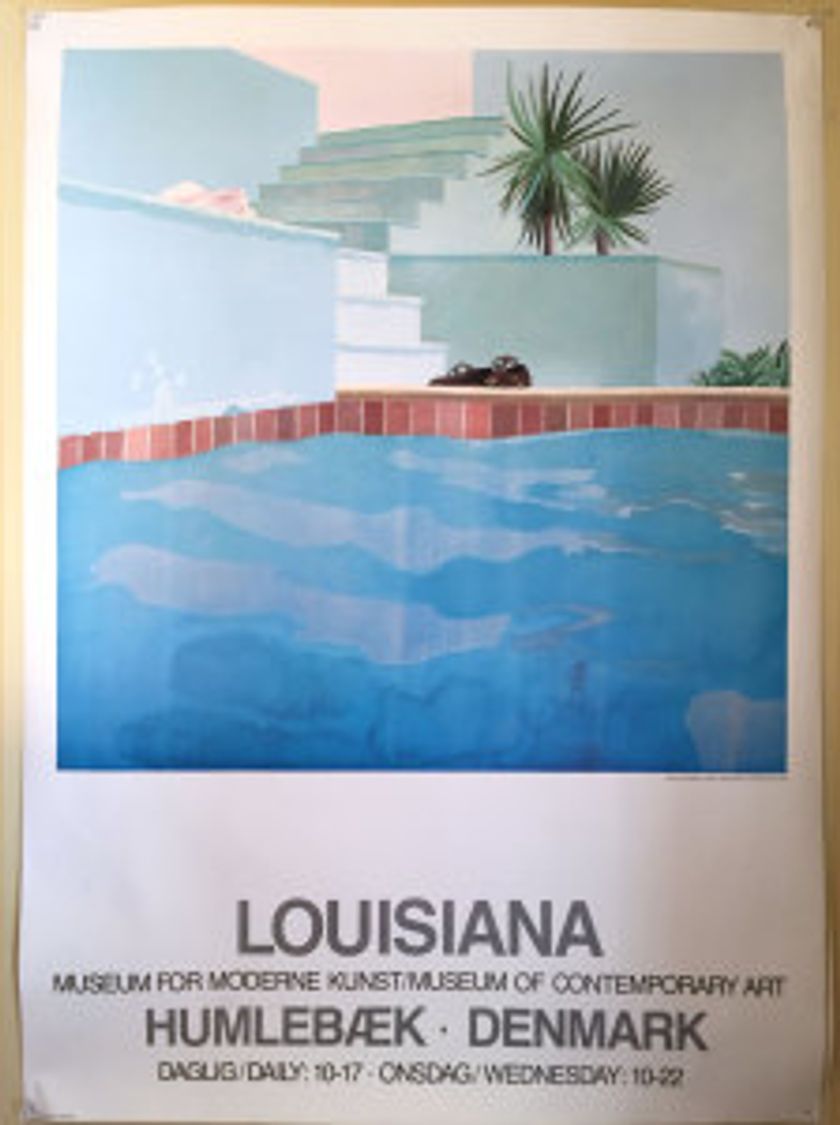
There’s a painting of David Hockney’s that I’ve always really loved, though never gotten around to writing about; but now, in the final craw of winter, it seems as good a time as any to dip into the image’s coy allure. It’s one of his pool paintings, which as a group played on all sorts of themes of surface and transparency and awareness and memory (the wet paint on canvas, drying, summoning the fading memory of what it was like to soak in the water that balmy distant afternoon, observing the dance of light on the surface of the water and to the depths beneath, mirroring what happens as we focus on the pigments on the canvas surface and through them, to the imputed image beyond, the pool, the sandals, the steps, the palms, whatever lies beyond—all of them, all of it, just so many pigments in play and yet so much more).